Fellowship in Medical Cosmetology: Who Should Consider This Program?
Medical cosmetology is becoming an important area of interest for doctors who want to expand their knowledge of skin, hair and non-surgical aesthetic procedures. Patients increasingly seek treatments that improve appearance without requiring major surgery.
A fellowship in medical cosmetology can help eligible medical professionals understand aesthetic consultation, patient selection and procedural safety. Training may also introduce technologies used for pigmentation, acne scars, hair loss and facial rejuvenation.
However, not every programme offers the same depth of education. Some courses focus mainly on theory. Others include clinical observation or supervised hands-on training. Eligibility can also vary between institutes.
A medical cosmetology fellowship does not replace a recognised dermatology or plastic surgery qualification. It provides additional training within the doctor’s existing professional scope. Applicants should therefore review the curriculum, supervision and certification before enrolling.
What Is Medical Cosmetology?
Medical cosmetology focuses on procedures that improve the appearance and quality of the skin or hair. It combines clinical assessment with aesthetic treatment planning.
Unlike a general beauty course, cosmetology training for doctors may cover medical history, contraindications and possible complications. Doctors also learn how underlying conditions can influence an aesthetic concern.
For example, facial pigmentation may be caused by melasma, post-inflammatory hyperpigmentation or contact dermatitis. Treating every brown patch with the same peel or laser may worsen the condition. Medical training helps the practitioner begin with diagnosis rather than selecting a procedure immediately.
A structured medical cosmetology fellowship may include:
Skin anatomy and physiology
Hair and scalp science
Aesthetic consultation
Facial assessment
Medical photography
Chemical peel principles
Laser and light-based technologies
Acne-scar management
Pigmentation treatment
Hair-restoration procedures
Injectable treatment concepts
Consent and documentation
Treatment aftercare
Complication recognition
The exact curriculum depends on the institute. Applicants should request a detailed module list before paying the course fee.
Who Can Pursue a Fellowship?
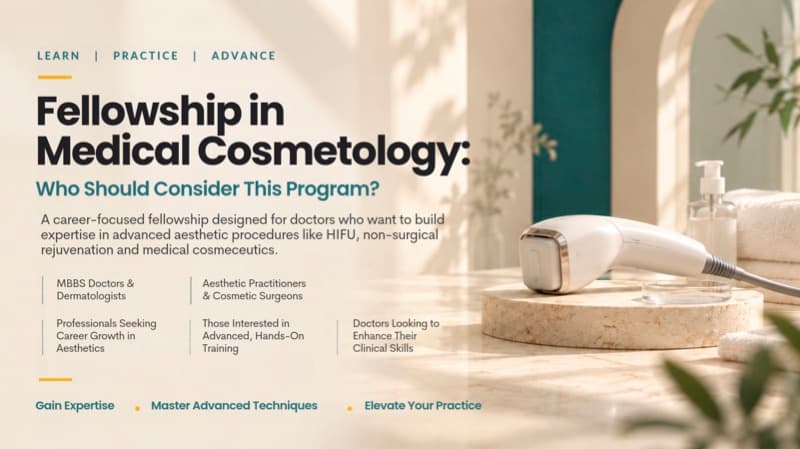
A fellowship in medical cosmetology is generally designed for registered medical professionals. The accepted qualifications depend on the institute and the procedures included in the programme.
Common eligibility may include:
MBBS doctors
Dermatologists with MD, DNB or DVD qualifications
Plastic surgeons
Other registered medical practitioners accepted by the institute
Dentists in programmes relevant to their permitted professional scope
Holding a medical degree does not automatically provide competence in every aesthetic procedure. Doctors still require structured education and supervised clinical training before performing unfamiliar treatments.
Applicants should confirm whether the programme is introductory or advanced. A doctor without previous aesthetic experience may need foundation-level instruction before progressing to complex procedures.
The term “fellowship” can also be used differently by different organisations. Some fellowships are private professional training programmes rather than university-recognised specialist qualifications. Students should verify the awarding body and certification status.
Most importantly, completing an aesthetic fellowship does not make a doctor a dermatologist. It should not be presented as a replacement for postgraduate residency or a recognised specialist degree.
Treatments and Technologies Covered
The procedures covered in a medical cosmetology fellowship vary according to its duration and practical structure. A comprehensive programme should explain both how a treatment works and when it should not be performed.
1. Skin Assessment and Treatment Planning
Doctors may learn how to assess skin tone, sensitivity and the primary concern. The consultation should also include medical history and previous cosmetic treatments.
Training may cover patient expectations and treatment suitability. Doctors should learn when to delay a procedure or refer the patient to another specialist.
2. Chemical Peels
Chemical peel training may introduce acids used for acne, pigmentation and surface texture.
The course should explain peel depth, skin preparation and neutralisation when relevant. Aftercare is equally important because unsuitable peels can cause irritation or post-inflammatory pigmentation.
Training for Indian skin should address the increased risk of pigment changes following inflammation.
3. Laser and Light-Based Procedures
An aesthetic fellowship may introduce laser physics and tissue targets. Doctors can learn how wavelength, fluence and pulse duration influence the treatment response.
Possible topics include:
Laser hair reduction
Pigmentation lasers
Fractional resurfacing
Vascular laser concepts
Intense pulsed light
Laser safety
Eye protection
Test spots
Learning the name of a device is not enough. The doctor must understand patient selection and possible adverse reactions. Each platform also requires device-specific training.
4. Injectable Treatment Concepts
Selected medical programmes may include botulinum toxin, dermal fillers or injectable skin-rejuvenation procedures.
Training should cover facial anatomy and sterile technique. Patient selection must receive equal attention. Doctors also need to recognise complications and understand when urgent management is required.
Injectable procedures should only be performed by appropriately qualified medical professionals within their legal scope. Practical training must take place under suitable clinical supervision.
5. Acne and Acne-Scar Treatment
Doctors may study active acne management before learning procedural scar treatment.
Acne-scar modules can introduce scar classification and combination planning. Procedures may include microneedling, subcision or fractional resurfacing concepts.
One procedure cannot correct every scar type. Treatment should be selected according to scar depth and skin tone.
6. Pigmentation Management
Pigmentation training may cover melasma, freckles and post-inflammatory marks. Doctors should learn that similar-looking patches can have different causes.
Treatment may involve medical skincare or superficial peels. Selected patients may also be considered for laser procedures.
Indian skin requires conservative treatment planning because inflammation can create additional pigmentation.
7. Hair and Scalp Procedures
Some programmes introduce the evaluation of hair fall and scalp conditions. Training may also cover supportive procedures such as platelet-rich plasma or other clinic-based hair treatments.
Doctors should learn when blood tests or medical therapy may be required. A procedure cannot correct untreated thyroid disease or a nutritional deficiency.
8. Complication Management
Complication training is essential in any medical cosmetology fellowship. Doctors should learn to recognise infection, burns and unusual swelling.
The programme should also explain documentation and emergency referral. Performing a procedure without knowing how to identify complications places the patient at risk.
Clinical Training
Clinical training helps doctors connect theoretical knowledge with real patient care. It should progress gradually according to the learner’s experience.
A programme may include:
Classroom or online theory
Treatment demonstrations
Clinical observation
Case discussions
Supervised patient assessment
Device familiarisation
Supervised hands-on procedures
Aftercare planning
Practical evaluation
Observation is not the same as hands-on experience. Applicants should ask which procedures they will perform and which ones they will only observe.
Hands-on training should take place under the supervision of an appropriately qualified professional. Patient consent must be obtained before a learner participates in treatment.
Doctors should also learn how to maintain treatment records. Notes may include the treatment area, product used and patient response. Device settings should be documented when relevant.
A short demonstration can introduce a procedure. It cannot create independent competence. Doctors may need additional mentoring and device-specific training after completing the fellowship.
Benefits for Medical Professionals
A medical cosmetology fellowship can help doctors develop a more structured approach to aesthetic concerns.
Better Patient Assessment
Training helps doctors distinguish between a cosmetic concern and a medical skin condition. This can prevent unsuitable treatment.
Safer Treatment Planning
Doctors learn to consider skin tone and previous reactions before choosing a procedure. This is especially important when treating pigmentation-prone Indian skin.
Improved Procedural Knowledge
An aesthetic fellowship can introduce the principles behind commonly used technologies. Doctors can then continue developing their skills through supervised practice.
Greater Awareness of Complications
Doctors learn to identify expected reactions and warning signs. Early recognition may reduce the severity of a complication.
Expanded Clinical Services
Eligible doctors may incorporate suitable aesthetic services into an existing medical practice after gaining adequate competence. The services offered must remain within their qualifications and applicable professional rules.
More Realistic Patient Counselling
Training can help doctors explain expected outcomes and treatment limitations. Clear counselling reduces unrealistic expectations.
Career Scope
The career scope after a fellowship in medical cosmetology depends on the doctor’s base qualification and practical competence.
Possible opportunities include:
Working in a dermatologist-led aesthetic clinic
Joining a medical spa with appropriate supervision
Assisting in laser or hair-restoration procedures
Providing permitted aesthetic consultations
Working with skincare or aesthetic-device companies
Developing an aesthetic service within an existing medical practice
Pursuing advanced training in a selected procedure
A certificate alone does not guarantee employment or independent practice. Employers may assess clinical judgement and procedural skills separately.
Doctors should avoid offering treatments immediately after limited observation. Competence develops through supervised clinical exposure and continued learning.
How to Choose a Medical Cosmetology Fellowship
Doctors should evaluate the programme carefully before enrolling.
Check the eligibility requirements and confirm whether the course is exclusively designed for medical professionals. The curriculum should clearly identify the procedures covered.
Ask whether training includes live demonstrations or supervised hands-on sessions. The institute should also explain how students are assessed.
Review the qualifications of the faculty. Medical procedures should be taught by professionals with relevant clinical experience.
Applicants should also confirm:
Course duration
Batch size
Patient exposure
Clinical supervision
Device availability
Complication-management training
Certification details
Post-course support
Complete fee structure
Avoid programmes that promise instant expertise or guaranteed income. Be cautious if a course claims that every doctor can independently perform advanced procedures after a brief workshop.
Medical Cosmetology Training at Skinfinity Academy of Cosmetology
At Skinfinity Academy of Cosmetology, our training pathways are structured according to the learner’s qualifications and career goals. Medical and non-medical training remain separate so that each participant learns within an appropriate professional scope.
Our medical cosmetology training pathway is designed for eligible doctors. It combines core theory with clinical observation and supervised practical exposure where applicable.
The programme may introduce aesthetic consultation and treatment planning. It can also provide exposure to selected skin, hair and laser procedures according to the current curriculum.
Eligibility may include recognised qualifications such as MBBS, MD, DNB or DVD. Doctors should contact our training team to confirm the latest modules and certification details before enrolment.
Participants can also ask about course duration, attendance requirements and the structure of hands-on sessions. Procedure availability may depend on patient suitability during the training period.
Conclusion
A fellowship in medical cosmetology may benefit doctors who want structured exposure to aesthetic medicine. The right programme should teach assessment, procedural safety and professional limitations.
Applicants should compare eligibility and supervision before enrolling. A fellowship supports additional skill development, but it does not replace specialist medical qualifications. Safe practice requires continued learning and experience with appropriately selected patients.
Frequently Asked Questions
Who Is Eligible for a Medical Cosmetology Fellowship?
Eligibility depends on the institute. Many programmes are designed for MBBS doctors or professionals with recognised postgraduate medical qualifications.
Applicants should confirm whether their degree meets the programme requirements before enrolling.
Is This Fellowship Suitable for Doctors?
Yes. A medical cosmetology fellowship is intended to help eligible doctors develop additional knowledge of aesthetic consultation and procedures.
The programme should match the doctor’s existing qualification and professional scope. It does not replace specialist training in dermatology or plastic surgery.
What Procedures Are Covered?
The curriculum may include chemical peels, laser principles and acne-scar treatment. Some programmes also introduce hair procedures or medical injectables.
Actual coverage varies by institute. Applicants should request a written curriculum that separates theory, observation and hands-on training.
Does It Include Hands-On Training?
Some fellowships include supervised hands-on training, while others provide only demonstrations or clinical observation.
Doctors should confirm which procedures they can practise and how much supervised exposure is provided. The phrase “clinical training” does not always mean independent hands-on treatment.