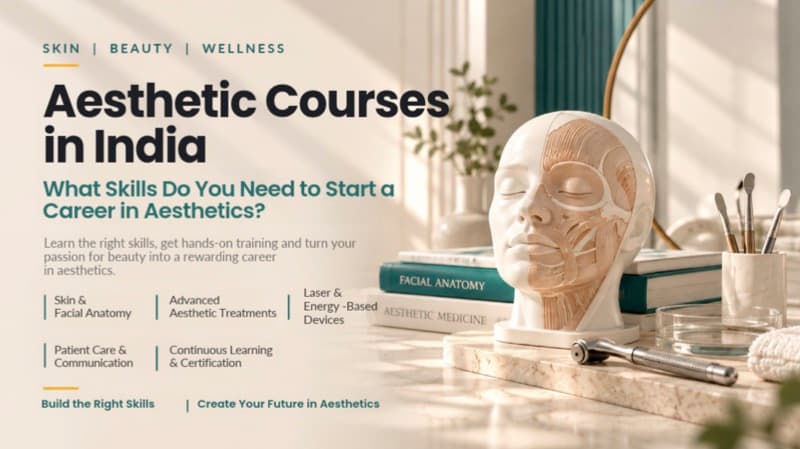
Aesthetic Courses in India: What Skills Do You Need to Start a Career in Aesthetics?
Aesthetic treatments have moved beyond conventional salon services. Clients now seek trained professionals who understand skin and treatment safety. They also expect suitable aftercare.
This shift has increased demand for aesthetic courses in India. However, entering the field requires more than learning a facial protocol or watching a device demonstration.
Aesthetic professionals must understand how the skin responds to different procedures. They should also know when a treatment must be postponed.
An aesthetic therapist course can provide structured education through classroom learning and clinical exposure. Longer programmes may also include supervised hands-on sessions.
The right programme depends on the student’s educational background. Career goals also influence course selection.
An aesthetic certification course does not replace a medical degree. Non-medical learners cannot diagnose skin diseases or independently perform invasive medical procedures.
What Is Aesthetic Training?
Aesthetic training teaches learners how professional treatments can support skin appearance. The course usually begins with skin science before introducing treatment protocols.
A structured programme may cover:
Skin anatomy
Skin physiology
Skin types
Skin analysis
Client consultation
Treatment contraindications
Hygiene practices
Infection control
Clinical facials
Superficial chemical peels
Microdermabrasion
Laser hair reduction concepts
Hair and scalp basics
Treatment aftercare
Professional documentation
Aesthetics training differs from a general beauty course. Beauty programmes may focus on makeup or salon grooming. An aesthetic course generally provides deeper education about skin responses.
Students learn why the same procedure cannot be used for every client. They also understand how sensitivity or active inflammation can affect treatment selection.
Course names can be misleading. A short programme may offer introductory theory only. A longer course may include practical exposure under supervision.
Students should review the curriculum before enrolling. Duration alone does not confirm course quality.
Skills Needed to Build a Career in Aesthetics
Technical ability develops through education and repeated practice. Aesthetic professionals also need sound judgement.
1. Understanding of Skin
Learners need a basic understanding of the epidermis and dermis. They should also study the skin barrier.
Knowledge of oil glands can help explain acne-prone skin. Hair-follicle education supports scalp care and laser hair reduction training.
2. Skin Analysis
A therapist should be able to observe dryness or oiliness. Sensitivity and visible pigmentation must also be considered.
Skin analysis supports suitable treatment planning. It does not allow a therapist to diagnose medical conditions.
Persistent acne or suspicious lesions require dermatologist assessment.
3. Knowledge of Contraindications
A procedure may be unsuitable when the skin is infected or inflamed. Open wounds can also require postponement.
Recent sunburn may increase the risk of irritation. Learners should know when to stop and refer the client.
4. Hygiene and Infection Control
Poor hygiene can lead to infection. It can also cause cross-contamination between clients.
Students should learn correct handwashing and treatment-area preparation. Reusable equipment must be disinfected according to protocol.
Single-use items should be discarded after treatment.
5. Equipment Handling
Modern aesthetic clinics use different facial and light-based devices. Learners must understand the purpose of the equipment before using it.
Training should explain basic device safety. Students should never operate unfamiliar equipment after watching only a brief demonstration.
6. Attention to Skin Response
A therapist must observe the client throughout treatment. Increasing redness or discomfort may indicate irritation.
Careful observation helps the therapist adjust or stop the procedure.
7. Client Communication
Clients may expect immediate results because of social media. A trained professional should explain what a procedure can realistically achieve.
The therapist should also discuss possible downtime. Aftercare instructions must be easy to understand.
8. Documentation
Treatment records help maintain continuity during future sessions. Notes may include the product used or treatment area.
Device settings should be recorded when applicable. Photographs require informed consent.
9. Professional Boundaries
An aesthetic certification course does not provide medical authority. Therapists cannot prescribe medication.
Injectable procedures require appropriately qualified medical professionals. Medical diagnosis also remains outside a therapist’s scope.
10. Continuous Learning
Products and aesthetic technologies continue to evolve. Professionals need further training when introducing unfamiliar treatments.
Learning should continue after course completion. Safe practice develops through experience under suitable guidance.
What Do You Learn in an Aesthetic Course?
The curriculum varies according to the institute and programme level. A good course should build knowledge gradually.
Skin Anatomy
Students learn about the structure of the skin. They may also study collagen production and pigmentation.
This foundation helps learners understand how different procedures affect the skin.
Skin Types and Concerns
The course may cover oily or dry skin. Combination skin and sensitive skin also require individual approaches.
Learners may study visible concerns such as dehydration or dullness. Medical conditions must be referred to a dermatologist.
Client Consultation
Students learn how to collect relevant information before treatment. This includes previous procedures and current skincare.
Allergies or medication use can influence treatment suitability. The client’s expectations should also be discussed.
Clinical Facials
An aesthetic therapist course may include basic Hydra facials and advanced protocols. Photofacials may also be introduced.
Students should understand the purpose of each treatment step. Memorising a fixed sequence is not enough.
Microdermabrasion
Microdermabrasion creates controlled surface exfoliation. Students learn how to prepare the skin and provide aftercare.
Over-treatment can cause irritation. Pigmentation-prone Indian skin may require additional caution.
Chemical Peels
Learners may study superficial chemical peel concepts. They should understand how peel selection depends on skin condition.
Strong peels can cause burns or post-inflammatory pigmentation. Medical-grade procedures require suitable qualifications.
Laser Hair Reduction
The curriculum may introduce hair anatomy and growth cycles. Students can also study how laser energy targets hair pigment.
Skin tone influences treatment planning. Laser safety should therefore receive adequate attention.
Hair and Scalp Care
Some programmes introduce scalp cleansing or basic hair concerns.
Unexplained shedding may have a medical cause. Clients with persistent hair loss require dermatologist evaluation.
Aftercare
Aftercare education helps protect the skin after treatment. Students may learn when active skincare should be paused.
Sun protection is often important after exfoliating procedures. Learners must also recognise warning signs that need medical review.
Aesthetic Courses for Therapists and Doctors
Therapists and doctors require separate training pathways. Their qualifications create different professional responsibilities.
Courses for Non-Medical Learners
Non-medical aesthetic courses may accept:
Class 12 graduates
Beauty therapists
Salon professionals
Makeup professionals
Skincare consultants
Wellness professionals
Beginners interested in aesthetics
An aesthetic therapist course may teach skin analysis and clinical facials. Selected superficial treatments may also be included.
Non-medical learners cannot prescribe medicines. They should not independently perform injectable or invasive medical procedures.
Some clinical procedures may be available for observation. Assistance under supervision does not create permission for independent practice.
Courses for Doctors
Doctors may choose separate medical aesthetics programmes. Eligibility depends on their recognised qualification and the institute’s requirements.
Medical courses may offer deeper education about patient assessment. They may also address procedure-related complications.
A short aesthetic course does not replace specialist postgraduate training. Doctors must continue practising within their recognised scope.
Why Separate Training Matters
Students should understand whether a procedure is therapist-level or doctor-led.
A responsible institute clearly identifies observation-only modules. It also explains which treatments include supervised practice.
This distinction protects the student and client.
Career Opportunities After Aesthetic Training
Career options depend on the learner’s course and practical ability. Previous work experience may also influence the available role.
Aesthetic Therapist
An aesthetic therapist may provide permitted non-medical treatments in a clinic or aesthetic centre.
Medi-Facial Therapist
A medi-facial therapist performs professionally developed facial protocols. The role requires careful product handling.
Dermatology Clinic Assistant
A clinic assistant may prepare treatment rooms and maintain records. Aftercare guidance may also be part of the role.
Medical procedures remain under the dermatologist’s responsibility.
Laser Hair Reduction Technician
Learners with suitable training may work in a supervised laser setting. Responsibilities depend on clinic policy.
Skincare Consultant
A skincare consultant may explain basic routines and product use. Medical concerns should be referred for professional diagnosis.
Permanent Makeup Artist
Learners who complete separate permanent makeup training may specialise in selected procedures. Adequate supervised practice is essential.
Clinic Coordinator
Experienced professionals may manage appointments and client follow-ups. They can also support treatment documentation.
Product or Equipment Trainer
Professionals with relevant experience may work with skincare brands or aesthetic-device companies.
An aesthetic certification course cannot guarantee employment. Career growth depends on practical competence and responsible work.
How to Choose the Right Aesthetic Institute
Students should evaluate the institute before paying the course fee.
Confirm Course Eligibility
Check whether the programme is intended for doctors or non-medical learners. The course should match the applicant’s existing qualification.
Request the Curriculum
Ask for a written module list. The institute should explain how deeply each treatment is covered.
Check Practical Exposure
Confirm whether the programme provides observation or supervised hands-on training. These are different learning formats.
Students should also ask whether suitable client interaction is included.
Review Faculty Qualifications
Find out who teaches the course. Medical modules require appropriately qualified supervision.
Assess Hygiene Standards
The training environment should follow professional infection-control practices. Equipment must be cleaned correctly between sessions.
Ask About Batch Size
Large groups may reduce practical opportunities. Students should ask how many learners share each demonstration.
Understand Certification
Confirm whether attendance is compulsory. Ask how students are evaluated before certification.
Avoid Unrealistic Claims
Be cautious if an institute promises instant expertise or guaranteed income.
Good aesthetics training explains professional limitations. It does not encourage learners to work outside their qualifications.
Aesthetic Courses at Skinfinity Academy of Cosmetology
At Skinfinity Academy of Cosmetology, our training programmes are structured according to the learner’s experience. Medical and non-medical pathways remain separate.
Our one-month Certificate Course in Clinical Cosmetology includes theory and demonstrations. Learners also receive observational exposure.
The programme does not include hands-on treatment or patient consultation. Injectable procedures are not included.
Our three-month Basic Clinical Cosmetology Course is designed for non-medical learners. It includes two months of theory and observation. The final month provides supervised hands-on exposure.
Modules may cover:
Skin anatomy
Skin analysis
Hair anatomy
Basic skin knowledge
Laser hair reduction
Basic Hydra facials
Advanced Hydra facials
Photofacials
Microdermabrasion peels
BioBright treatments
Scalp cleansing
Chemical peels
Hair-mesotherapy assistance
Our six-month Advanced Skin Aesthetic Therapist Course includes broader therapist-level education. It also offers two months of supervised hands-on training.
The programme introduces permanent makeup and selected advanced procedures. Patient interaction takes place under professional supervision.
Doctors require a separate medical cosmetology course suited to their recognised qualifications.
Students interested in aesthetic courses in India can contact skinfinity Academy for current schedules. Eligibility and practical structure should be confirmed before enrolment.
Conclusion
A career in aesthetics begins with suitable training and a clear understanding of professional boundaries.
The right aesthetic therapist course should explain skin science and treatment safety. It should also provide the level of clinical exposure promised during admission.
Students must select training that matches their qualifications. Continued learning remains important after certification.
Frequently Asked Questions
What Are Aesthetic Courses?
Aesthetic courses teach skin science and professional treatment concepts. Selected programmes also include supervised practical exposure.
The curriculum depends on course duration and learner eligibility.
Who Can Join an Aesthetic Course?
Some programmes accept Class 12 graduates or complete beginners. Beauty professionals may also enrol.
Medical aesthetics courses generally require a recognised medical qualification.
What Skills Are Required for an Aesthetic Career?
Learners need an understanding of skin and strong hygiene practices.
They should recognise contraindications and communicate clearly with clients.
Are Practical Sessions Included in Aesthetic Courses?
Some courses provide observation only. Longer programmes may offer supervised hands-on sessions.
Students should confirm the exact practical structure before enrolling.
What Career Opportunities Are Available After Aesthetic Training?
Learners may work as aesthetic therapists or medi-facial therapists. Clinic-assistant roles may also be available.
Additional training can support work in permanent makeup or professional product education. Every role must remain within the learner’s permitted scope.